





Part I
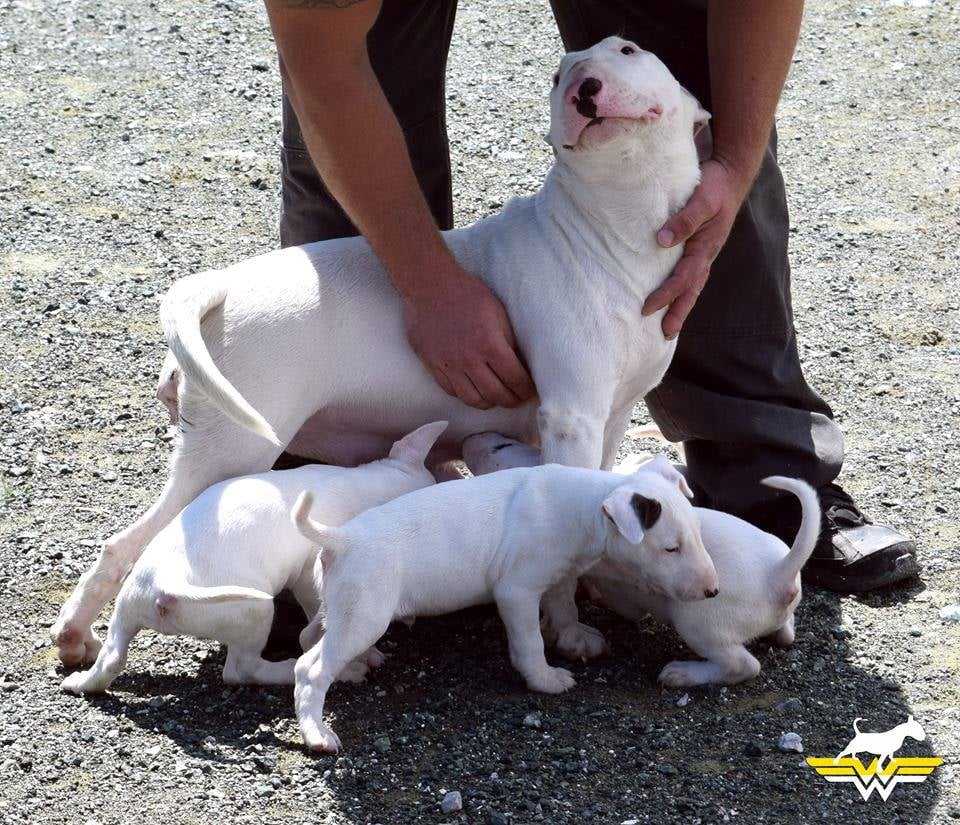
We have often mentioned how important it is for the puppies to stay with their litter-mates and their mother at least until they reach their 12th week. We have also mentioned the critical periods for socialization.
In this article we will refer to some very important reasons why the puppies must stay with their litter-mates and how that will shape their character and social skills.
Most animals use clear signs of submission to show that they accept their defeat in order to end a fight and avoid serious injury.
Dogs lie on their back exposing their abdomen and throat. Dogs and their predecessors wolves are species with the most refined aggression inhibition mechanisms. What is of great interest is how they develop these mechanisms in a very young age.
At the age of about 4-5 weeks, puppies will show the first signs of aggressive behaviour. Then , the first fights begin within the litter-mates group, they actually go looking for it. They put no effort to minimize the hostilities. At this age, whether it be for something important like a bone or food or for something worthless, the first aggressive episodes will take place among the litter- mate group. This fighting will give them their first lesson on how to become social animals. Soon they will understand that they cannot handle their siblings through aggression and fear so they will start following different tactics.
This is the age when the puppies have grown teeth and the mother is usually somewhat unwilling to feed them. If the puppies go to feed one at a time, it will not happen because mother will growl at them and send them away, one by one. But if they all go together at once then they will succeed. And this is the first time the puppies work together, cooperate.
At this age the puppies play by wrestling and biting one another. Until the time comes for a puppy to bite another on the ear real hard with his needle sharp teeth. The bitten puppy will shriek with pain and will look for an opportunity to bite on a soft spot in return and then they will both shriek with pain .This is not what it looks like. Even if it looks like they are killing each other and you feel an urgent need to do something about it, you must not. They will remain motionless for a few seconds and then release their bite, both of them.
They have both learned their lesson. Next time a puppy bites a sibling during play, it will be until he hears by the other puppy, a sound of discomfort that will work as a mechanism to inhibit or control aggressive behaviour. Last time the puppy heard a sound like that , was painful for him too.
We have said before and we will say again that no human can offer a puppy the socialization a puppy will get growing up with his litter-mates and mother. On this we are adamant and that is why we keep our puppies until they reach a minimum of 12 weeks of age.
We will give you another example to understand how important staying with their litter-mates and mother is for their socialization.
Imagine the mother is eating a bone while the puppies roam and play with one another. One of the puppies realizes that mother is eating and approaches her. The closer the puppy gets the more the mother growls but the puppy ignores her and goes for the bone. At a distance of about 30 centimetres from the bone, with a swift jump the mother grabs the puppy by the muzzle and pins the puppy down. The puppy gets scared, starts whining and moves away. Ten minutes later the puppy approaches the mother eating the bone again.
This time, at the sound of growling the puppy freezes. Right away, the puppy starts licking the air , moving his hind leg aside and waving with his front leg. This is called Pacifying Behaviour because it results in ending the opponent’s aggressive behaviour. Pacifying behaviours are patterns used before for different functions. All these functions have common sides of pleasure. The puppy performs the same moves that until then have brought him pleasant experiences.
The licking is connected to breast feeding. The rear leg that moves to the side to the mother licking the puppy’s belly when the puppy was younger and the front leg waving also to breast feeding specifically the stimulation of milk production.
Even though unaware of it, the puppy has just learned his first lesson on Ritualized Behaviour. The mother teaches her puppies how to compromise and survive.
Life lessons that can only be taught by their own species. We will never be in any position to teach these very important lessons to puppies in such a direct and precise manner. These are lessons that will define their lives and social skills.
To be continued…
📚 Want to Raise the Best Bull Terrier You Can?
If you enjoyed this article, we’ve got two must-have eBooks written by the team behind Working Bull Terriers Kennel—based on years of real experience with this amazing breed.
🐶 1. Dear Human: 150 Things Your Bull Terrier Would Like You to Know
A humorous, heartfelt guide written from your dog’s perspective—covering training, health, routines, and life together, from the Bull Terrier’s point of view.
📙 2. 20 Essential Rules for Bull Terrier Owners
Packed with real-world advice, this book walks you through everything from puppy training and exercise to behavior, grooming, and building a strong lifelong bond.
🛒 Check out both eBooks—and more—here.
🎁 Special Offer for Our Readers:
Use the promo code WBT10 at checkout to get 10% off anything in our shop—eBooks, merch, training tools, and more!
👉 Visit the shop now.
Thank you for supporting our work and helping your Bull Terrier live their best life! 🐾
Leave a Reply